

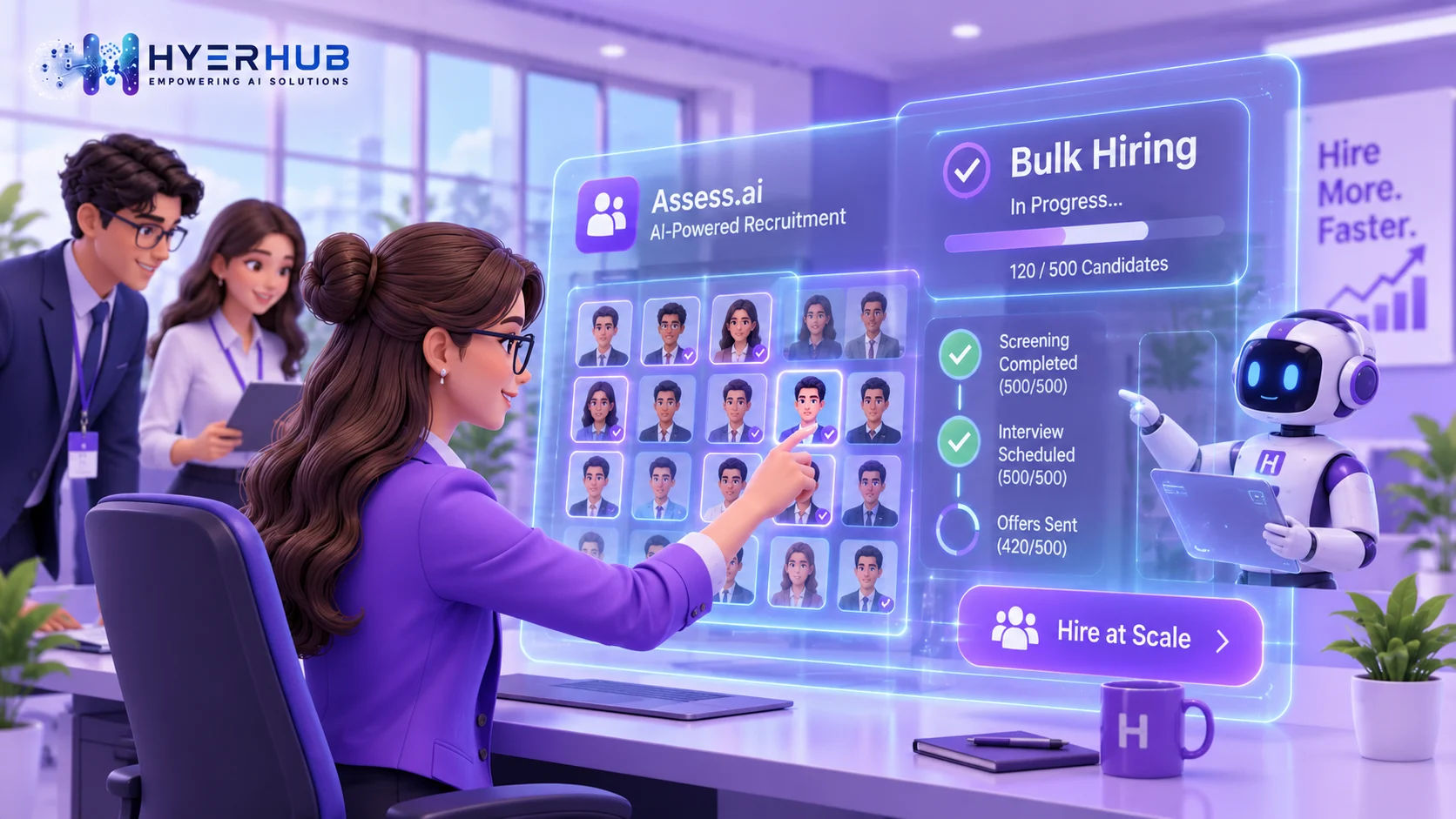
Hiring one person is a process. Hiring 50, 500, or 5,000 is a logistics problem.
Seasonal surges, new branch openings, campus drives, and rapid expansion all create the same challenge. You need many qualified people, in a short window, without lowering the bar. Most teams respond by adding more recruiters and more spreadsheets. That works for a while, then breaks down in scheduling, inconsistent evaluation, and burnout.
This guide covers what bulk hiring is, where it goes wrong, and how to build a repeatable process that scales. It also covers how AI-led interviews, like HyeRHub Assess, remove the biggest bottleneck: screening.
What Is Bulk Hiring?
Bulk hiring (also called high-volume or mass recruitment) is filling a large number of similar roles in a short period. Common scenarios include:
- Campus and fresher drives: hundreds of graduates assessed in a single hiring season
- Seasonal staffing: retail, logistics, and hospitality ramp-ups
- Customer support and BPO teams: large cohorts hired for training batches
- New location launches: a whole team assembled before opening day
- Rapid growth: startups and enterprises scaling a function quickly
The roles are usually similar, the timelines are tight, and the applicant volume is high. That combination is what makes the process hard to manage manually.
Why Bulk Hiring Is So Difficult
Before fixing the process, it helps to know where it breaks.
- Screening doesn't scale. A recruiter can only run so many calls a day. When 2,000 applications arrive for 100 openings, shortlisting becomes the bottleneck, and good candidates wait in the queue until they accept other offers.
- Evaluation becomes inconsistent. When ten interviewers assess candidates in different ways, results vary with the interviewer, not the candidate. This hurts quality of hire and fairness.
- Scheduling eats time. Coordinating calendars across hundreds of candidates and multiple interviewers is a full-time job on its own.
- Candidate experience suffers. Slow replies and unclear next steps push strong candidates away, and they rarely come back.
- Resumes only tell part of the story. Resumes show history. They don't show communication, problem-solving, or how someone handles real scenarios, which matter most in high-volume roles.
- Assessment integrity is hard to verify. In remote screening, it's difficult to know whether the person answering is the person who applied, or whether they had outside help.
A Step-by-Step Framework for Bulk Hiring
Step 1: Define the role and the rubric first
Before posting anything, define what "good" looks like. List the must-have skills, the nice-to-haves, and the behaviors that predict success in the role. Turn these into a scoring rubric that every evaluator uses. A clear rubric is the foundation of consistent, fair, scalable hiring. Without it, volume only multiplies inconsistency.
Step 2: Plan your timeline and numbers backward
Work backward from your start date. Estimate the funnel: how many applicants you need to get enough interviews, how many interviews to get enough offers, and how many offers to account for drop-offs. Build in a buffer, since offer acceptance rates are rarely 100%.
Step 3: Source across multiple channels
Don't rely on one source. Combine:
- Job boards and your careers page
- Employee referrals
- Campus partnerships and placement cells
- Social media and professional networks
- Talent pools from previous hiring cycles
Keep the application process short and mobile-friendly. Every extra form field costs you applicants.
Step 4: Screen at scale with structured, consistent evaluation
This is where most bulk hiring programs succeed or fail. Instead of manual phone screens, use a structured first-round evaluation that every candidate completes in the same way, against the same criteria. AI interview platforms are built for this, and HyeRHub Assess is designed to handle exactly this stage. The next section covers its benefits in detail.
Step 5: Assess more than one dimension
High-volume roles still need the right fit. A well-rounded evaluation covers:
- Technical or functional skills for the role
- Communication, both verbal and written
- Behavioral traits like collaboration and work style
- Situational judgement through real-world scenarios
- Cognitive ability for reasoning and problem-solving
- Integrity and ethics for reliability and professional values
Step 6: Shortlist using data, not gut feel
Once results are in, rank candidates by score and review the top performers in detail. Use dashboards to track your pipeline: who has been invited, who has completed the interview, and who is ready for the next round. Shareable reports help hiring managers weigh in quickly, which shortens the decision cycle.
Step 7: Keep communication fast and clear
In bulk hiring, silence is the biggest candidate experience killer. Set expectations early, confirm receipt of applications, share timelines, and notify candidates promptly about outcomes. Automated updates make this manageable at volume.
Step 8: Close offers and plan onboarding
Move quickly from selection to offer. Strong candidates in high-volume pools often hold multiple offers. Then plan onboarding for the whole cohort: training schedules, documentation, equipment, and a clear first-week experience.
Benefits of HyeRHub Assess for Bulk Hiring
Screening is the stage where bulk hiring slows down most, so it is also where the right tool makes the biggest difference. HyeRHub Assess runs structured AI voice and video interviews that evaluate communication, technical ability, behavioral traits, and confidence, while continuously monitoring interview integrity. Here is what that means for your hiring team.
1. Faster screening without adding headcount
AI interviewers can run many interviews at the same time. Instead of a recruiter working through candidates one call after another, every applicant can complete a full interview on their own time. Your shortlist is ready sooner, and strong candidates don't drift away while waiting for a slot.
2. No scheduling back-and-forth
Manual interviewing means coordinating calendars, sending reminders, and rescheduling no-shows. With Assess, candidates simply complete their interview when it suits them. That frees recruiters from the administrative work that eats most of their day during a hiring drive.
3. Consistent, fair evaluation for every candidate
Every candidate is scored against the same role-specific rubric, with the same questions and the same criteria. This removes the interviewer-to-interviewer variation that creeps in at scale, and it gives you a defensible, comparable basis for every shortlisting decision.
4. A fuller picture than a resume or a static test
Resumes and one-time tests show only part of a candidate's potential. Assess evaluates multiple dimensions in one flow: technical skills, communication, behavioral traits, situational judgement, cognitive ability, integrity, domain knowledge, and psychometric traits. You see how someone thinks and communicates, not just what they have listed.
5. Role-specific assessments, not generic tests
Assess analyzes the job description, required skills, and competencies to build an evaluation blueprint for that role. The questions, scenarios, and challenges are tailored to what the job actually needs, which makes results far more relevant than a one-size-fits-all test.
6. Built-in integrity monitoring
Remote screening raises a fair question: is the result trustworthy? Assess includes proctoring that checks the face, voice, extra people in frame, phones, and device changes during the interview. This helps protect the reliability of your results when you are screening large numbers of people remotely.
7. Instant, actionable hiring insights
Each interview produces a structured report with an overall score, a breakdown by skill area, and clear strengths and gaps. Instead of piecing together scattered notes, hiring managers get a consistent summary they can act on right away.
8. Clear dashboards and a single candidate pipeline
Track every candidate's interview status and score for each job in one place. Simple dashboards show top performers, score breakdowns, and key hiring metrics, so you can see exactly where your bulk hiring drive stands at any moment.
9. A better candidate experience
Candidates get a conversational, adaptive interview they can take at a convenient time, with no long waits for a recruiter to call back. A smoother, more respectful process helps protect your employer brand, which matters when you are interviewing hundreds of people at once.
10. Your team stays in control of the decision
Assess does the repetitive first-round work. It does not make the hire. Reports are shareable so recruiters and hiring managers can collaborate, and the final decision stays with your team. That keeps human judgement where it matters most.
Benefits at a glance
| Challenge in bulk hiring | How HyeRHub Assess helps |
|---|---|
| Screening bottleneck | AI interviews run in parallel, so recruiters aren't limited by calls per day |
| Scheduling overhead | Candidates interview on their own time, with no calendar coordination |
| Inconsistent evaluation | Same questions and same rubric for every candidate |
| Shallow resume data | Multi-dimensional assessment of skills, communication, and behavior |
| Integrity concerns | Proctoring for face, voice, extra people, phones, and device changes |
| Scattered feedback | Instant reports with scores, strengths, and gaps |
| Poor pipeline visibility | Dashboards tracking each candidate's status and score per job |
Common Bulk Hiring Mistakes to Avoid
- Skipping the rubric. Without agreed criteria, scale amplifies bias and inconsistency.
- Over-relying on resumes. Resumes rarely reveal real skills or communication ability.
- Making the process too long. Every extra step loses candidates.
- Ignoring candidate experience. Rejected candidates talk, and so do the ones you never replied to.
- Treating technology as the decision-maker. AI should inform decisions, not make them. Keep humans accountable for the final call.
- Forgetting integrity checks. Remote screening needs safeguards to keep results trustworthy.
Key Metrics to Track
Measure your bulk hiring process so you can improve the next round.
| Metric | Why it matters |
|---|---|
| Time-to-hire | Shows how fast you move from application to offer |
| Time-to-screen | Reveals your biggest bottleneck |
| Cost-per-hire | Tracks efficiency as volume grows |
| Offer acceptance rate | Indicates candidate experience and offer competitiveness |
| Completion rate | Shows whether your assessment process is too long or confusing |
| Quality of hire | Measures performance and retention after joining |
How AI Is Changing Bulk Hiring
Manual screening was never designed for thousands of applicants. AI-led interviews change the equation by making first-round evaluation instant, consistent, and available around the clock. Candidates interview when it suits them, and recruiters receive structured results instead of scattered notes.
The best results come from combining the two: AI handles volume and consistency, while your team handles judgment, relationship-building, and final decisions.
Final Thoughts
Bulk hiring doesn't have to mean lower quality or burned-out recruiters. With a clear rubric, a structured screening process, and the right technology, you can recruit at scale and still hire people who are the right fit.
Start by fixing your biggest bottleneck, which is almost always screening. Once every candidate is evaluated fairly and consistently, everything downstream gets faster and easier.
Ready to see how it works? Request a demo of HyeRHub Assess and watch a live AI interview tailored to the roles you're hiring for.
Key Takeaways
- Define the role and scoring rubric before you start sourcing.
- Work backward from the start date and budget for drop-offs at each stage.
- Screen with consistent, role-specific criteria and give candidates clear updates.
- Track time-to-screen, completion rates and quality of hire to improve the next hiring round.
- Use AI interview reports to inform shortlisting and keep final decisions with your hiring team.