Test scores and technical assessments measure only a small part of a candidate's potential. The future of hiring lies in AI-powered, multidimensional evaluation that combines skills, behavior, and role alignment to predict real-world performance.
HyeRHub.ai Assess helps hiring teams make more accurate, consistent and fair decisions — so you hire for potential, not just performance on a test.
1. Why Traditional Assessments Fall Short
Most hiring processes still rely heavily on technical tests, aptitude and experience. But research and real-world outcomes show these factors alone don't predict long-term success in a role.
The appeal of a test score is that it looks like an answer. It is a number, it can be ranked, and it makes a decision feel defensible. But a score measures performance on the test, and the gap between that and performance in the role is where most bad hires live.
Timed algorithm puzzles are the clearest example. They measure recall of a particular body of material under artificial pressure — a skill that correlates with recent interview preparation more than with engineering judgement. A candidate who has spent three months drilling puzzles outperforms one who has spent three years shipping systems, and the score reports that faithfully.
Years of experience has the same problem in a different form. It is easy to count and almost meaningless on its own: five years of steadily harder problems and five years of the same year repeated look identical on a resume. So does a strong performer in a weak team and a weak performer in a strong one.
What Traditional Assessments Measure
- Technical knowledge
- Aptitude & IQ
- Certifications
- Academic background
- Years of experience
What Modern Hiring Requires
- Communication
- Collaboration
- Learning agility
- Adaptability
- Problem solving
- Decision-making
- Cultural alignment
- Motivation & drive
2. Hiring Is Becoming Multidimensional
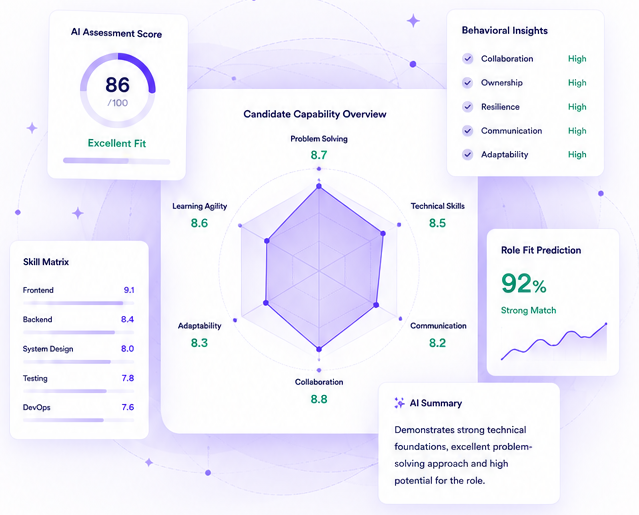
Successful hiring evaluates candidates across multiple dimensions instead of relying on a single score. The goal is to understand how a candidate thinks, works and grows.
In practice that means deciding, before anyone is assessed, what the role actually demands — and being specific. A role that mostly involves untangling legacy systems nobody documented rewards patience and investigative instinct. A role defining a product from nothing rewards tolerance for ambiguity and the judgement to stop exploring and commit. Both need technical competence; neither is well served by the same generic test.
Multidimensional does not mean measuring everything. A dozen dimensions produce a profile too noisy to act on and an assessment too long for anyone to finish. Three or four that genuinely differentiate performance in this role beat a comprehensive battery that differentiates nothing.
The dimensions also have to be defined behaviourally to be assessable. “Communication” is not a criterion; “can explain a technical trade-off to someone without the background, and check they followed” is something you can watch happen and score.
3. The Role of AI in Candidate Assessment
AI's role is to structure and score dimensions that are hard for a single human reviewer to evaluate consistently across hundreds of candidates — how someone communicates under pressure, how they approach an unfamiliar problem, how they collaborate in a simulated exercise.
AI doesn't replace judgment. It turns unstructured signals into structured, comparable evidence a recruiter can act on.
The practical gain is consistency at volume. A panel of interviewers applying the same rubric still drifts — across time zones, across the fifth interview of the day, across interviewers who disagree about what “good” means and have never compared notes. A structured assessment applies the same standard to the four hundredth candidate as to the first, which makes candidates genuinely comparable rather than nominally so.
It matters just as much what this should not do. An assessment that returns a number and no reasoning cannot be reviewed, challenged, or explained to a candidate who asks why. Every dimension should carry the evidence behind it — what the candidate said or did that produced the score — so a recruiter can disagree with it on the specifics.
4. Beyond Technical Skills
Technical skill is necessary but rarely sufficient. The people who succeed in a role tend to share a second layer of traits — how they learn, how they handle ambiguity, how they work with others — that a pass/fail coding test or IQ score was never designed to capture.
AI-powered assessment adds that layer without adding hours to the hiring process.
Two traits do most of the work in that second layer. The first is how someone behaves when they do not know the answer: whether they narrow the problem, state assumptions and ask, or freeze and bluff. Almost every role encounters unfamiliar problems, and that response is more predictive than whether they happened to know today's question.
The second is how someone responds to being wrong. Given a correction mid-exercise, do they incorporate it and move on, or defend the original position? It is difficult to elicit in a conversational interview and straightforward to observe in a structured one, and it predicts how someone will work with colleagues long after the hiring decision is made.
5. Building a Fairer Hiring Process
A single test score amplifies whoever wrote the test. A multidimensional, structured assessment applied consistently to every candidate reduces the room for that kind of drift — everyone answers the same prompts, is scored against the same rubric, and is evaluated on the same set of dimensions regardless of who's reviewing the file.
Structure narrows the room for bias but does not eliminate it, and it is worth being precise about why. A model trained on who a company hired in the past will reproduce the past, and it will do so with the appearance of objectivity — which makes it harder to challenge than an interviewer's hunch, not easier.
So fairness has to be measured continuously rather than asserted at launch. That means tracking outcomes across groups at every stage, watching for proxies that encode background rather than ability, and treating a divergence as a defect to investigate. A system nobody is checking is not a fair system; it is an unexamined one.
Accessibility belongs in the same conversation. Time limits, video requirements and unfamiliar tooling all test things unrelated to the job. Assessments should be designed so that adjustments are routine and easy to ask for, rather than a favour a candidate has to negotiate.
6. Where Human Judgment Matters Most
None of this replaces the recruiter or hiring manager. AI surfaces a structured, comparable picture of each candidate; a human still decides who to interview, who to hire, and how a specific candidate's strengths map to the specific team they'd be joining.
The assessment narrows the field with more signal — it doesn't make the call.
There is a specific kind of judgement no assessment reaches: what this particular team needs right now. A team that has shipped fast and accumulated fragility needs someone who will insist on paying it down. The same team a year later, stable and slow, needs something else. Both candidates score well; only one is the right hire this quarter.
Context that never reaches an assessment matters too — a candidate recovering from a bad manager, someone whose strongest work is under NDA, a career change where the transferable part is obvious to a person and invisible to a rubric. This is why HyeRHub.ai treats assessment output as evidence for a decision rather than the decision: a recommendation with its reasoning attached, for a person to accept or overrule.
7. The Future of Talent Intelligence
As assessment data accumulates across roles and teams, the same system that scores an individual candidate starts to reveal patterns — which dimensions actually predict success in a given role, and what a strong hire in that role has tended to look like.
That shift, from single-candidate scoring to organization-wide talent intelligence, is where AI-powered assessment is headed next.
The prerequisite is honest outcome data, and it is where most organisations stop. Knowing which dimensions predict success requires knowing who actually succeeded — which means performance signals fed back against assessment scores months later, not a hiring funnel that ends at the offer.
Done carefully, this closes a loop that has been open in hiring for decades: it shows which of your criteria were load-bearing and which were superstition. Done carelessly, it entrenches whatever the organisation already rewarded. The difference is whether anyone is willing to act on a finding that contradicts a long-held belief about what a good hire looks like.
Conclusion
Test scores will keep playing a role in hiring, but as the primary signal for who gets hired, their era is ending. The organizations that hire best in the years ahead will be the ones that evaluate the whole candidate — skills, behavior and fit together — with AI doing the structuring and people making the decision.