Evolution of ATS
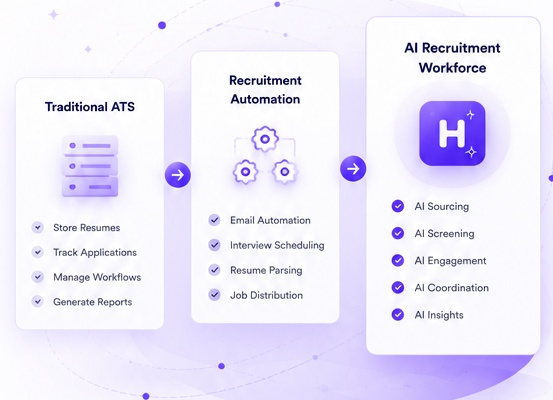
The first Applicant Tracking Systems replaced filing cabinets. They gave recruiting teams a searchable database instead of a stack of paper resumes, and for a long time that was enough. As application volume grew through online job boards, ATS platforms added keyword filters and Boolean search to help recruiters triage faster.
Over the past decade, most ATS vendors layered on “AI features” — resume parsing, ranking scores, chatbot scheduling — bolted onto the same underlying model: a system of record that recruiters operate manually, one candidate and one requisition at a time.
It is worth appreciating what that generation solved, because it was real. Before applicant tracking, a requisition lived in a filing cabinet and an inbox, applications were lost routinely, and there was no way to answer “who have we already spoken to?” A searchable, shared, auditable record of every candidate was a genuine advance, and it remains valuable.
The limitation is architectural rather than a matter of missing features. These systems were designed around the requisition as the unit of work and the recruiter as the only actor. Every stage begins with a person opening a screen and doing something. Adding a ranking model to that does not change who has to act — it changes what they see when they act.
Why ATS is Reaching Its Limits
A system of record is passive by design. It stores what a recruiter enters and surfaces what a recruiter searches for — it doesn't go find candidates, doesn't evaluate them beyond keyword overlap, and doesn't coordinate the dozens of small handoffs (screening calls, interview scheduling, status updates) that make up a hiring process.
That leaves the busywork on the recruiter: chasing candidates for availability, re-entering the same information across disconnected tools, and screening resumes for keywords that correlate poorly with actual job performance. The result is a familiar pattern — strong candidates lost to slow processes, and recruiters with too little time for the parts of the job that actually require judgment.
Count the tools a single hire passes through in most organisations: the ATS, a sourcing tool, LinkedIn, a calendar, email, a scheduling link, an assessment platform, a spreadsheet for scorecards, a chat channel for the debrief, and an HRIS for the offer. None shares a candidate record with the others. The recruiter is the integration layer, and re-entering the same details across ten systems is where a significant part of the week goes.
The keyword problem compounds it. Ranking on term overlap rewards candidates who mirror the job description's vocabulary, which is a proxy for having been coached rather than for being capable. Recruiters know this, which is why many work around the ranking and read more widely — and then volume makes that impossible, so the ranking decides after all.
AI Workforce
An AI workforce inverts the model. Instead of a system that waits for a recruiter to act, specialized AI teammates actively execute each stage of the pipeline — sourcing candidates from multiple channels, screening and scoring them against the role, coordinating interview logistics, and keeping candidates informed — while surfacing their work for human review at every meaningful decision point.
The distinction isn't “more automation.” It's a shift from software the recruiter operates to a team the recruiter supervises.
Recruiters still make every hiring decision. What changes is how much of the repetitive coordination work happens before a decision is even needed.
“Supervises” is doing real work in that sentence, and it deserves specifics. Supervision means the agent's work is visible rather than opaque: what it did, on what evidence, and what it proposes next. It means defined points where it must stop and wait — an offer, a rejection, anything flagged. And it means the ability to overrule without fighting the system, because a control that is technically present but awkward to use is not a control.
This is also why the layer has to reach into the tools an organisation already runs rather than replacing them. A coordinated AI workforce that only works if you migrate your ATS, your calendar and your HRIS first is not a realistic proposition for an enterprise — and the migration is where most of these programmes die before they demonstrate anything.
Benefits
- Recruiters spend more of their time on conversations and judgment calls, less on administrative coordination.
- Candidates get faster, more consistent responses instead of waiting on manual follow-up.
- Evaluations follow a structured, repeatable process instead of varying by whoever happens to review a resume.
- Hiring capacity scales with demand without a proportional increase in recruiting headcount.
Future of Hiring
The enterprises that adapt fastest won't be the ones that automate the most tasks — they'll be the ones that redesign the recruiter's role around judgment and relationships, with an AI workforce handling the coordination underneath it. That's an organizational shift as much as a technology one, and it starts with treating AI teammates as part of the team, not a feature added to the old system of record.
That redesign changes what a recruiter is measured on. Requisitions closed and time-to-fill made sense when the constraint was throughput and the recruiter was the bottleneck. When coordination is handled underneath them, the work that remains is quality of hire, candidate experience, and the judgement calls at the decision points — none of which the old metrics capture.
Adoption follows the same logic. The teams that get value do not switch everything at once; they take the stage where their own process actually stalls, hand that one over, measure it honestly, and move on. Scheduling is a common first step because the delay is measurable and nobody enjoys the work. Screening usually comes later, because it needs the most oversight and carries the most risk if it goes wrong unwatched.
Conclusion
Traditional ATS platforms will keep serving as a system of record for a while yet. But as the standalone source of how hiring gets done, their era is ending. The next decade of recruiting belongs to organizations that pair human judgment with an AI workforce built to execute the process around it.
Key Takeaways
- Traditional ATS platforms were built as a passive system of record, not an active hiring engine.
- Keyword-matching and bolted-on “AI features” don’t change that underlying passive model.
- An AI workforce actively sources, screens, coordinates and engages candidates end to end.
- Recruiters stay in control of every decision — the AI workforce removes the coordination overhead around it.
- The shift is organizational as much as technological: redesigning the recruiter's role around judgment, not admin work.