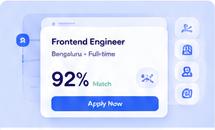

1. Job Posted: Reaching the Right Talent
A hiring process starts the moment a role is posted, and where it's posted matters as much as how it's written. Distributing a job across the channels where qualified candidates actually spend their time — rather than a single job board — is the difference between a shallow applicant pool and a genuinely competitive one.
Most job descriptions are written for the company rather than the candidate. They open with a paragraph about the organisation, list a dozen “must-haves” that are really nice-to-haves, and bury the part a candidate is actually deciding on: what they will work on, who they will work with, and what the first six months look like. A description that leads with the work attracts people who want that work.
The requirements list deserves particular scrutiny. Every additional non-essential requirement narrows the pool, and it does not narrow it evenly — under-represented candidates are more likely to self-select out when they do not meet every listed criterion. Separating what someone genuinely cannot do the job without from what they could learn in a quarter widens the field without lowering the bar.
Distribution is the other half. A role posted to one board reaches the people already browsing that board today. The same role syndicated across general boards, specialist communities, your own careers page and your employees' networks reaches a materially different population — and candidates who arrive through a referral or a specialist community tend to convert further down the funnel than those who arrive through a generic listing.
2. AI Sourcing: Finding Candidates Before They Apply
Not every strong candidate is actively applying. AI sourcing widens the funnel by identifying and engaging people who match a role's requirements but haven't seen the posting yet, turning a passive job listing into an active search.
The distinction that matters here is between matching and searching. A keyword search returns profiles containing the words you typed, which rewards candidates who happen to describe their work the way your job description does. Matching works the other way round: it reads what a role actually requires, reads what a person has actually done, and reasons about the overlap — so a “platform engineer” who has spent three years building internal developer tooling surfaces for an infrastructure role even if the two job titles share no words.
That reasoning extends to adjacent experience. Someone who has scaled a payments integration at a fintech has solved a recognisable set of problems that transfer to a different industry with the same technical shape. Keyword search cannot see that. A model that understands the work can, and the candidates it surfaces are frequently the ones a recruiter would have found valuable but would never have thought to search for.
Sourcing at volume also raises a fairness question worth answering before it is asked. Outreach generated and sent without oversight becomes spam quickly, and evaluation that runs without review becomes a black box. The useful version keeps a person in the loop on both: the AI proposes a shortlist and drafts the approach, and a recruiter decides who is worth contacting and what is actually said.
3. Smart Screening: Evaluating at Scale Without Losing the Human Touch
Manually screening every application doesn't scale, but screening on keywords alone misses good candidates. AI-assisted screening applies a consistent, structured evaluation to every applicant, so recruiters spend their time reviewing a shortlist instead of a stack.
Traditional applicant tracking systems rank on keyword density, which produced a predictable result: candidates learned to game them. Skills sections stuffed with terms lifted from the job description, white text on a white background, keyword tables at the foot of the page. The arms race did not make screening more accurate — it made resumes worse, and it advantaged candidates who knew the trick over candidates who did the work.
Structured evaluation replaces the keyword count with a rubric defined per role: the capabilities that matter, what evidence of each looks like, and how much weight each carries. Every applicant is then assessed against the same rubric in the same way. That consistency is worth as much as the accuracy — two candidates with comparable evidence get comparable scores whether they were reviewed first or four hundredth, on Monday morning or Friday evening.
Two properties separate screening you can defend from screening you merely trust. The first is explainability: a score that arrives without reasoning cannot be reviewed, corrected, or explained to a candidate who asks. Each assessment should cite the evidence it drew on. The second is monitoring: bias does not announce itself, so outcomes need measuring across groups continuously rather than auditing once at launch.
And screening should shortlist, not reject. The defensible design has AI narrowing hundreds of applications to a set a human can genuinely consider, with the decision to advance or decline staying with the recruiter. That is the line HyeRHub.ai draws structurally rather than as a setting.
4. Interview Scheduling: Removing the Back-and-Forth
Coordinating interview times across candidates, hiring managers and panels is one of the most common places a hiring process stalls. Automated scheduling removes the email back-and-forth, so an interview gets booked in hours instead of days.
The delay is rarely anyone's fault. A recruiter proposes three slots; the candidate is available for one; by the time they reply, the hiring manager has taken a meeting in it. Multiply that by a four-person panel, two time zones and a candidate who cannot speak freely during working hours, and a week disappears into logistics. Meanwhile the candidate is interviewing elsewhere, and the company that booked them in two days is further ahead.
Automated scheduling reads the real constraints — panel availability, interviewer load, time zones, the candidate's own stated preferences — and books the slot that works, then handles the rescheduling when someone drops out. What used to be a dozen emails becomes a confirmation.
It is worth designing this stage around the candidate rather than the calendar. Evening and early-morning options acknowledge that most candidates are employed. Clear guidance on who they will meet, how long it will take and what the session covers reduces the anxiety that makes interviews go badly for reasons unrelated to ability.
Job Posted
Reach the right talent across channels.
AI Sourcing
AI finds and engages relevant candidates.
Smart Screening
AI screens and ranks candidates instantly.
Interview Scheduling
AI coordinates and schedules interviews.
Candidate Engagement
Personalized communication at every step.
Interview & Feedback
Structured interviews and real-time feedback.
Decision & Offer
Faster decisions, better candidate experience.
5. Candidate Engagement: Keeping Candidates Informed
Silence is the fastest way to lose a candidate. Automated, personalized updates at every stage of the process keep candidates informed of where they stand — without adding another task to a recruiter's list.
Candidates rarely disengage because a process is slow. They disengage because it is silent, and silence is ambiguous in a way that slowness is not. A week with no word is indistinguishable from a rejection nobody sent, so people protect themselves by assuming the worst and committing elsewhere. “We are still interviewing, you will hear from us on Thursday” costs nothing and removes the ambiguity entirely.
Personalisation here means relevance, not a merge field. Inserting a first name into a generic template is transparent to everyone who receives it. A useful update references the role, the stage they have reached, what happens next and when — which is exactly the information a recruiter would give if they had time to write to every candidate individually.
The same applies to the end of the process. A candidate declined after three rounds who then hears nothing tells other people about it, and the reputational cost lands on roles you have not posted yet. Closing the loop promptly, with something more specific than a form letter where it is warranted, is the cheapest employer-brand work available.
6. Interview & Feedback: Structured, Consistent Evaluation
Interview feedback is only useful when it's comparable. Structured interview formats and real-time feedback capture give hiring teams a consistent basis for comparing candidates, instead of relying on memory and informal notes after the fact.
Unstructured interviews are among the most heavily criticised tools in hiring, and the reason is well understood: when every candidate is asked different questions, there is nothing to compare. What gets compared instead is the interviewer's impression — shaped by how recently the conversation happened, how closely the candidate resembles the interviewer, and how the previous interview went. A structured format asks the same questions against the same rubric, so the comparison is between candidates rather than between impressions.
Capturing evidence during the interview rather than after it matters more than it sounds. Notes written an hour later are a reconstruction, and reconstructions compress toward the overall feeling the interviewer already formed. Scoring each area as it is discussed, against criteria agreed in advance, keeps the record closer to what was actually said.
This is where AI interviewing earns its place — and where its limits belong in writing. It can run a consistent structured interview at a scale no panel can staff, score against an agreed rubric, and hand back a transcript with the evidence attached. It should not decide. Every HyeRHub.ai interview produces a recommendation and the reasoning behind it for a person to review; the hiring decision stays with the hiring team.
7. Decision & Offer: Faster Decisions, Better Experience
The final stretch of a hiring process is where momentum matters most. With structured feedback already in hand, hiring teams can move from final interview to decision — and decision to offer — without the delays that give a strong candidate time to accept somewhere else.
Most of the delay at this stage is not deliberation. It is assembling what deliberation needs: chasing the interviewer who has not written up their notes, reconciling scores recorded in four different formats, scheduling a debrief that five calendars can agree on. When evidence has been captured consistently throughout, the debrief starts with the comparison already made and spends its time on the decision instead of the paperwork.
Speed at this point is not the same as haste. The goal is to remove the waiting that adds nothing — the days a candidate spends wondering, which are also the days a competing offer lands. A structured process shortens exactly those gaps while leaving the deliberation itself intact.
Approval is the one place worth keeping deliberately slow. Offers and rejections carry consequences that do not reverse cleanly, which is why HyeRHub.ai routes both to a named human reviewer in the Command Center rather than letting an agent send them. Automation gets the decision-makers everything they need; it does not stand in for them.
Conclusion
Every stage of hiring — from the job post to the offer letter — is an opportunity to either build momentum or lose it. Automating the repetitive parts of that journey doesn't remove the human element from hiring; it protects the time recruiters need to spend on it, right when it matters most.
No single stage above is transformed by automation on its own. The compounding comes from removing the handoffs between them: the application that sits unread over a weekend, the scheduling thread that runs for a week, the scorecard written from memory, the debrief nobody could book. Each is a small delay, and together they are the difference between a two-week process and a six-week one — which is usually the difference between hiring your first choice and hiring your third.
The teams that get the most out of this do not start by automating everything. They find the stage where their own process actually stalls, fix that one, measure it, and move to the next. The goal is not a pipeline that runs without people. It is a pipeline where the people spend their time on judgement rather than on logistics.
Key Takeaways
- A slow hiring process loses strong candidates before an offer is ever made.
- AI sourcing surfaces qualified candidates who aren't actively applying.
- Structured screening and interviews make evaluations consistent and comparable.
- Automated scheduling and updates remove the delays candidates notice most.
- Faster decisions lead to a better candidate experience — not a lower bar.