Hiring the right candidate is about more than finding someone with an impressive resume. Recruiters also need to understand a candidate's technical knowledge, communication skills, problem-solving ability, and suitability for a specific role.
However, traditional interviews can make this challenging. Scheduling multiple interviews, asking consistent questions, evaluating different candidates, and documenting feedback all require significant time and coordination.
This is where an AI interview platform can help.
An AI interview platform uses artificial intelligence to conduct structured candidate interviews, assess job-related skills, analyse responses, and generate insights that support recruitment decisions. It helps organisations make their interview processes more consistent, efficient, and data-informed.
But how does this technology actually work? And when should a business consider using one?
Let's explore.
What Is an AI Interview Platform?
An AI interview platform is a recruitment technology solution that uses artificial intelligence to support or conduct candidate interviews.
Depending on the platform, it can use voice-based conversations, video interviews, or text-based interactions to ask candidates relevant questions and evaluate their responses against predefined job requirements.
Instead of relying entirely on manual interviews and subjective notes, recruiters can use AI-generated transcripts, assessment results, competency insights, and structured reports to understand candidate performance.
An AI interview platform may help assess areas such as:
- Technical skills: Role-specific knowledge, programming ability, tools, and practical expertise.
- Communication skills: Clarity, articulation, and the ability to explain ideas.
- Problem-solving: Logical reasoning and approaches to workplace challenges.
- Behavioural competencies: Collaboration, leadership, adaptability, and decision-making.
- Domain knowledge: Understanding of the industry or professional function.
- Situational judgement: How candidates respond to realistic workplace scenarios.
The exact capabilities depend on the platform and the assessment configured by the employer.
The goal is not simply to automate conversations. It is to help hiring teams collect more structured, relevant information before making a decision.
How Does an AI Interview Platform Work?
An AI interview platform typically follows a structured process, from understanding the job requirements to generating candidate assessment insights.
Here is how the process works.
1. Understand the Job Requirements
The process begins with the job description.
The hiring team defines the role, responsibilities, required qualifications, experience, and essential competencies. An AI-powered assessment system can analyse these requirements and help identify the skills that should be evaluated.
For example, a software developer role may require programming knowledge, logical reasoning, debugging ability, and communication skills.
A customer support role may prioritise communication, problem-solving, product knowledge, and customer handling.
The assessment should reflect what candidates actually need to perform in the role.
2. Create a Personalised Interview
Once the requirements are established, the platform can help create a structured interview.
Questions may cover technical knowledge, behavioural competencies, situational judgement, or role-specific scenarios.
For example, a project management interview might include a question such as:
“Describe how you would handle a project that is falling behind schedule because of unexpected resource constraints.”
A well-configured platform keeps questions and evaluation criteria relevant to the position.
Candidate Profile-Based Interviewing
An AI interview platform can consider both the job description (JD) and the candidate's profile while conducting the interview. This helps tailor the interview questions to the role requirements as well as the candidate's qualifications, experience and background.
Rather than following only a generic set of questions, the interview can explore relevant areas based on the information available in the candidate's profile.
Additional Topics and Questions
Recruiters can also provide additional topics or specific questions they want the AI interviewer to cover during the assessment.
This gives hiring teams greater flexibility to include role-specific requirements, technical areas or other important subjects that may not be covered by the standard interview questions.
3. Candidates Complete the AI Interview
Candidates participate through the interview format supported by the platform.
This may include:
- Voice-based AI interviews.
- Video-based AI interviews.
- Text-based question-and-answer sessions.
- Technical or situational assessment exercises.
The AI interviewer presents questions and captures candidate responses. Some platforms also support conversational follow-up questions, allowing the interview to explore a candidate's answers in greater depth.
Depending on the interview design, candidates may be able to complete an assessment remotely without coordinating a traditional interview slot with multiple interviewers.
4. AI Evaluates Candidate Responses
After collecting responses, the platform analyses them against predefined, job-related evaluation criteria.
For example, a technical assessment may evaluate whether a candidate understands a concept, explains a solution logically, and demonstrates the required technical knowledge.
A communication assessment may examine how clearly the candidate explains an idea and organises their response.
The platform can then organise these observations into structured assessment results.
The quality of the evaluation depends on the assessment design, the criteria used, and the reliability of the underlying technology. AI-generated scores should be treated as decision-support information rather than unquestionable conclusions.
5. Assessment Integrity and Fairness Are Considered
Reliable candidate evaluation requires more than asking questions and generating scores.
Organisations also need to consider whether candidates are completing assessments under appropriate conditions and whether evaluation criteria are applied consistently.
Depending on the platform, assessment integrity features may include identity or environment checks, monitoring signals, and other proctoring capabilities.
Fairness also requires carefully designed questions, job-related scoring criteria, regular evaluation of outcomes, and appropriate human oversight.
AI should support a structured recruitment process, not become an unchecked authority over candidate selection.
6. Recruiters Receive Reports and Hiring Insights
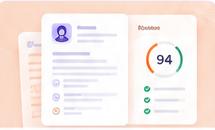
Once the assessment is complete, the platform can generate reports that help recruiters understand candidate performance.
These insights may include:
- Assessment scores across different competencies.
- Candidate response summaries.
- Technical and behavioural evaluation results.
- Areas of strength and potential development.
- Side-by-side candidate comparisons.
- Recommendations for further human evaluation.
- Recorded interview summary: A recorded summary of the interview helps recruiters revisit the discussion, review important responses and understand the candidate's assessment more conveniently.
Recruiters and hiring managers can use this information to decide which candidates should progress to the next stage.
The final hiring decision should remain with the organisation's human decision-makers.
Key Benefits of Using an AI Interview Platform
AI interview platforms can improve several parts of the recruitment process when they are implemented thoughtfully.
1. More Efficient Interview Processes
Traditional interviews require coordination between candidates, recruiters, and hiring managers.
AI-supported interviews can reduce some of this manual work by standardising question delivery, collecting responses, and organising assessment information.
This can be particularly useful when an organisation receives a large number of applications.
2. More Consistent Candidate Evaluation
Different interviewers may ask different questions or interpret similar answers differently.
Structured AI-assisted assessments can apply consistent questions and evaluation criteria across candidates.
This gives recruiters a more organised basis for comparing candidates, although consistent scoring does not automatically guarantee unbiased results.
3. Better Visibility Into Candidate Skills
A resume may demonstrate previous experience, but it cannot always show how effectively someone communicates, solves problems, or applies knowledge.
Role-specific interviews and assessments can provide additional evidence about a candidate's capabilities.
This helps hiring teams look beyond qualifications and job titles.
4. Reduced Administrative Work
Recruiters often spend time reviewing responses, organising interview notes, preparing evaluation summaries, and comparing candidates.
AI-generated transcripts, summaries, and reports can help streamline these activities.
Recruiters can then dedicate more time to candidate engagement, stakeholder discussions, and final evaluation.
5. More Structured Hiring Decisions
Hiring decisions become easier to discuss when assessment results are organised around clearly defined competencies.
Instead of relying entirely on general impressions, hiring managers can review evidence from different assessment areas.
This supports more transparent discussions about candidate strengths, gaps, and role requirements.
6. A More Scalable Recruitment Process
Businesses hiring for multiple roles or locations may struggle to maintain a consistent interview process.
AI interview platforms can help standardise assessments across larger candidate groups, provided the evaluation criteria are appropriately adapted to each role.
This makes them particularly relevant for organisations with recurring or high-volume recruitment needs.
When Should a Business Use an AI Interview Platform?
An AI interview platform is not necessary for every hiring situation. Its value depends on recruitment volume, role requirements, assessment complexity, and the organisation's hiring objectives.
Here are some situations where it can be particularly useful.
1. High-Volume Recruitment
Companies hiring hundreds or thousands of candidates may find manual first-round interviews difficult to manage.
AI-supported interviews can help collect structured information from candidates and organise results for recruiter review.
Example: A retail company hiring customer service representatives across several locations can use structured interviews to assess communication and customer-handling skills.
2. Technical Recruitment
Technical roles often require more than checking qualifications or reviewing a resume.
An AI interview platform can support structured technical assessments covering programming concepts, troubleshooting, technical knowledge, and problem-solving.
Example: A software company hiring developers can evaluate candidates against role-specific technical competencies before arranging deeper technical discussions.
3. Remote and Distributed Hiring
When candidates and hiring teams are located in different cities or countries, arranging interviews can become complicated.
Remote AI interviews can make it easier to collect candidate responses without requiring everyone to participate in a live meeting at the same time, where the platform supports asynchronous interviews.
Example: A global organisation can use structured remote interviews to assess candidates across different locations.
4. Graduate and Entry-Level Recruitment
Graduate recruitment often involves evaluating a large number of candidates with limited professional experience.
In these situations, employers may want to assess communication, aptitude, reasoning, learning ability, and role-specific potential.
AI-supported assessments can help organise this evaluation process.
5. Standardising Recruitment Across Departments
Large organisations may have multiple departments conducting interviews with different approaches.
A structured platform can help establish consistent assessment frameworks while allowing the questions and competencies to vary according to each role.
This is useful when organisations want greater consistency without treating every position as identical.
6. Recurring Recruitment Campaigns
Companies that regularly recruit for similar positions can benefit from reusable assessment structures.
Once the relevant competencies and evaluation criteria are established, teams can use them as a starting point for future hiring campaigns and refine them when role requirements change.
AI Interview Platform vs Traditional Interview: What's the Difference?
Both approaches can play an important role in recruitment. The difference is how interviews are conducted, documented, and evaluated.
| Area | Traditional Interview | AI Interview Platform |
|---|---|---|
| Interview process | Usually conducted by a human interviewer | AI supports or conducts the interview |
| Scheduling | Often requires coordination | May support flexible or asynchronous interviews |
| Question delivery | Can vary by interviewer | Can follow structured question frameworks |
| Evaluation | Often relies on interviewer notes and judgement | Can provide structured, AI-generated assessment insights |
| Reporting | Feedback may need manual documentation | Can generate organised reports and summaries |
| Scalability | Requires additional interviewer time | Can support larger assessment volumes |
| Human involvement | Direct throughout the interview | Important for reviewing results and making decisions |
An AI interview platform should not necessarily replace traditional interviews.
For many organisations, the strongest approach is a combination of AI-supported initial assessment and human-led interviews for deeper evaluation, relationship building, and final hiring decisions.
What Should You Look for in an AI Interview Platform?
Choosing the right platform requires more than comparing features.
Businesses should consider whether the solution supports their hiring process and provides meaningful, reliable assessment information.
Here are some important factors to evaluate.
1. Role-Specific Assessments
The platform should support assessments based on the actual requirements of different positions rather than relying on generic questions for every candidate.
2. Multiple Assessment Types
Look for support for relevant evaluation areas, such as technical, communication, behavioural, cognitive, and situational assessments.
3. Clear Evaluation Reports
Recruiters should be able to understand why a candidate received a particular assessment result. Clear reporting and supporting evidence are more useful than unexplained scores.
4. Candidate Experience
The interview process should be straightforward, accessible, and easy to understand. Candidates should know what to expect and how their responses will be used.
5. Assessment Integrity
Consider whether the platform provides appropriate security and assessment integrity features for the organisation's requirements.
6. Fairness and Human Oversight
Ask how the platform supports consistent evaluation, how potential bias is monitored, and how recruiters can review AI-generated results before making hiring decisions.
7. Data Protection and Security
Understand how candidate information is collected, stored, processed, retained, and protected. Review the provider's privacy and security documentation before implementation.
How HyeRHub.ai Assess Supports AI-Powered Interviews
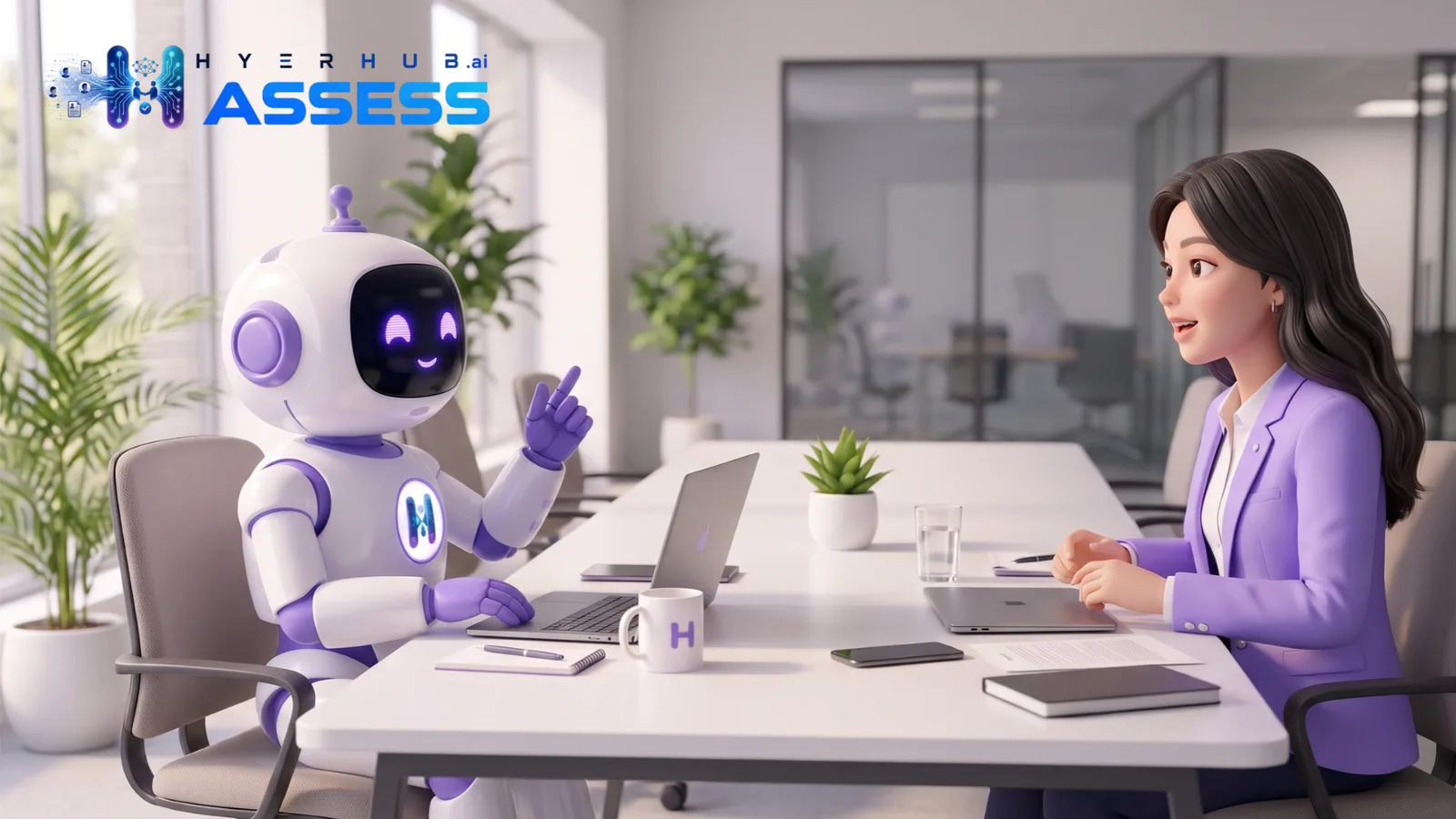
HyeRHub.ai Assess is designed to help organisations move beyond basic screening and build a more structured approach to candidate evaluation.
Its AI interview platform brings together voice and video interviews, role-specific assessments, evaluation insights, and assessment integrity capabilities.
The platform follows a six-step assessment journey:
- Understand the Role: Analyse the job description and identify the required skills and competencies.
- Create a Personalised Assessment: Build an assessment journey with relevant questions, scenarios, and challenges.
- Engage Candidates: Provide candidates with an interactive assessment experience using conversational AI.
- Evaluate and Analyse: Assess responses across areas such as skills, logic, communication, and behaviour.
- Support Integrity and Fairness: Use assessment integrity and bias-related safeguards as part of the evaluation process.
- Generate Insights: Organise assessment results into reports, hiring-readiness insights, and role-fit recommendations.
An important part of the personalised interview experience is that the platform considers both the job description and the candidate's profile while conducting the interview. Recruiters can also provide additional topics and specific questions they want covered, helping align the assessment with their hiring requirements.
HyeRHub.ai Assess supports different assessment dimensions, including technical skills, communication, cognitive ability, situational judgement, behavioural competencies, integrity, domain knowledge, and psychometric assessments.
Its reporting capabilities also help recruiters review assessment results, compare candidates, and access actionable insights. The platform also provides a recorded interview summary, making it easier for recruiters to revisit key parts of the discussion and review candidate responses.
For organisations looking to make interviews more structured and gain a deeper understanding of candidate capabilities, this approach can be a useful addition to the recruitment process.
Explore the HyeRHub.ai Assess AI Interview Platform to see how it can support your hiring and assessment needs.
Frequently Asked Questions About AI Interview Platforms
What is the main purpose of an AI interview platform?
The main purpose is to support candidate interviews and evaluation using artificial intelligence. It can help organisations conduct structured interviews, assess job-related competencies, organise candidate responses, and generate insights for recruiters.
Can an AI interview platform conduct interviews automatically?
Yes. Depending on its capabilities, an AI interview platform can conduct voice, video, or text-based interviews by presenting questions and capturing candidate responses. Some platforms also support adaptive conversations and follow-up questions.
Are AI interview platforms suitable for technical hiring?
Yes. They can support technical assessments involving programming knowledge, role-specific expertise, logical reasoning, and problem-solving. The assessment should be designed around the technical requirements of the position.
Does an AI interview platform replace human recruiters?
No. It is best used as a tool that supports recruitment teams. AI can help collect and organise assessment information, but recruiters and hiring managers should review the results and make the final hiring decisions.
Can AI interview platforms reduce hiring time?
They can help reduce time spent on certain repetitive activities, such as coordinating interviews, collecting responses, and preparing assessment summaries. The actual impact depends on recruitment volume, implementation, and the organisation's existing process.
Are AI interview platforms suitable for small businesses?
Yes. Small businesses can use AI interview platforms when they need a more structured way to evaluate candidates but have limited recruitment resources. The right solution depends on hiring frequency, budget, and assessment requirements.
How can organisations ensure fairness when using AI interviews?
Organisations should use job-related assessment criteria, review evaluation methods for potential bias, provide accessible interview experiences, protect candidate data, and maintain meaningful human oversight. AI-generated scores should not be treated as the sole basis for hiring decisions.
Final Thoughts
Recruitment is becoming increasingly complex, particularly for organisations managing large candidate pools, specialised roles, and distributed hiring teams.
An AI interview platform can help make candidate assessment more structured by combining intelligent interviews, role-specific evaluation, and organised reporting.
However, successful implementation requires more than automation. Organisations need relevant assessment criteria, transparent evaluation processes, responsible data handling, and human involvement in important hiring decisions.
By combining AI-powered assessments with recruiter expertise, businesses can build a more consistent and informed approach to finding the right talent.
Ready to explore a smarter approach to candidate assessment?
Discover HyeRHub.ai Assess and see how AI-powered interviews can support your recruitment process.